
A passion for bonsai, from nursery to shop floor
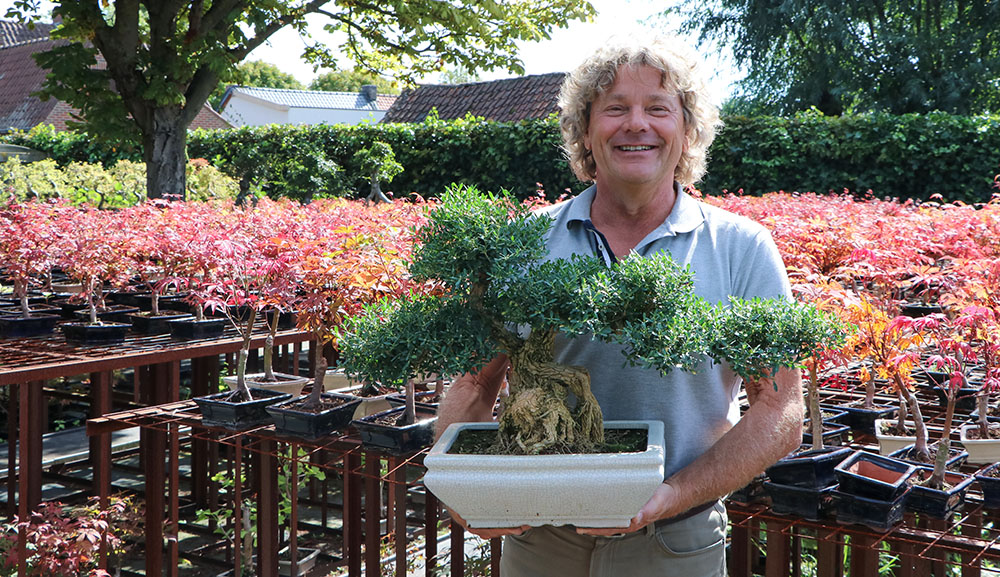
Anyone stepping into Euro Bonsai immediately realises that bonsai is much more than just a small tree in a pot. Behind every plant lies a story of years of cultivation, selection, shaping and expertise. Marc Makelberge knows that world like no other. Trained as a garden and landscape architect, he has a natural eye for form, proportion and greenery. That background found a unique expression in the world of bonsai. For almost thirty years, he has been building up Euro Bonsai from his base in Lochristi, with a clear specialisation: a wide and carefully selected range for garden centres and specialist bonsai shops across Europe.
That expertise often begins thousands of kilometres away. Marc travels to China four times a year to select plants himself and monitor the quality of the orders. And he does so very deliberately.
“I go to China myself to pick out the very best.”
Four times a year to the source
China is currently the main source of Euro Bonsai’s bonsai range. In southern China, Marc selects the indoor bonsai, which are imported all year round. For the outdoor bonsai, he travels to the north of the country.
There, the rhythm is entirely in tune with nature. Outdoor bonsai can only be dispatched once the leaves have fallen and the plants are dormant. This takes place from late autumn until the end of winter. Euro Bonsai also works with a specialist grower in Portugal for Mediterranean species.
A visit to China is, moreover, about much more than discovering new plants. Orders are placed months in advance and meticulously checked on site. Are the pot, shape and potting soil correct? Has the plant been pruned correctly? Has the wiring been carried out properly? Only when the overall picture is right is Marc satisfied.
With the larger and more unusual specimens, he goes one step further: each one is hand-selected.
No two bonsai are the same
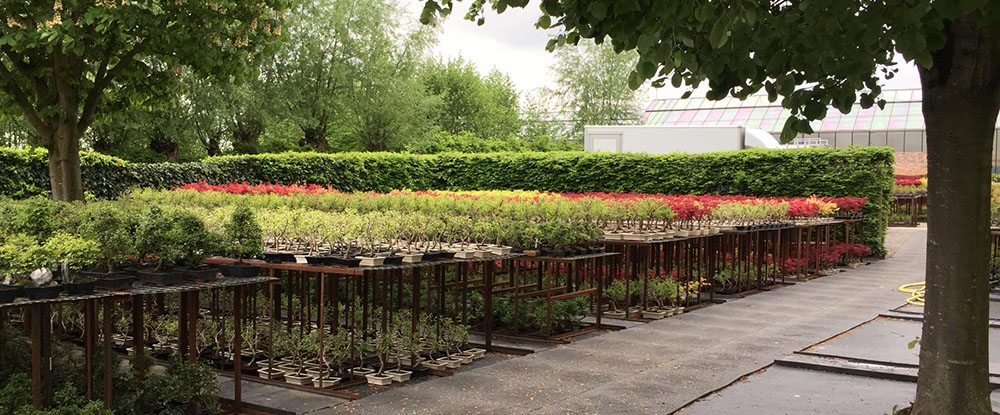
That is precisely where much of the appeal lies. Euro Bonsai offers around thirty different varieties, divided into indoor, outdoor and Mediterranean bonsai. But the actual range is much broader. Different ages, shapes, pots and sizes make every selection unique.
What’s more, some of the plants receive an extra upgrade upon arrival in Lochristi. Around twenty per cent of the bonsai are reselected and repotted into a more distinctive pot, finished with, amongst other things, akadama, the well-known Japanese clay granules.
This creates a range that goes beyond standard bonsai.
“Different shapes, different pots, different sizes, different ages: that’s precisely what makes the range so interesting.”
A long journey requires patience
The journey from the nursery to Europe is by no means straightforward. Bonsai from China are shipped to Europe in sea containers. The plants are carefully prepared and packed – including wrapping moss around the root ball – and travel in climate-controlled containers.
Nevertheless, transport remains a factor that is difficult to control entirely (due to the geopolitical situation). A planned fast route may be diverted en route to a longer alternative, adding several extra weeks to the journey.
Upon arrival, the plants are therefore given the necessary time at Euro Bonsai to recover from the long journey. They are unpacked, tended to and fed, and pruned again where necessary. Only when their quality has returned to the desired standard are they ready for sale.
This characterises our way of working: not rushing to dispatch them as quickly as possible, but first ensuring the plant is ready for the next stage.
From mass production to specialisation
The market in which Euro Bonsai operates has changed significantly over the past few decades. Whereas large promotional volumes used to form a significant part of the trade, the company has now consciously chosen a different course.
The focus is on day-to-day trade and a wide range for garden centres and specialist shops in Belgium, France, Germany and other European markets. There is no single major campaign that dictates the entire business operation, but rather continuity and choice throughout the year.
Spring remains an important period, and demand also rises around Mother’s and Father’s Day. However, bonsai is now much less tied to a single sales period.
This gives garden centres the opportunity to establish it as a proper product category.
Not just any plant on a table
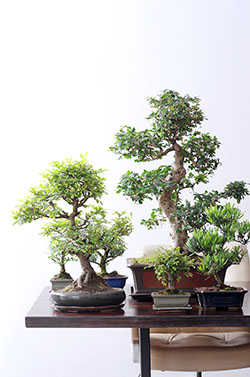
According to Marc, this is precisely where one of the greatest commercial opportunities lies. Simply placing a few bonsai amongst other houseplants is rarely enough. The category needs context.
“You need to establish a concept. Just putting one or two boxes of bonsai somewhere won’t sell.”
A good display starts with a clear, recognisable spot in the garden centre. Combine different sizes and price points and place a striking specimen as an eye-catcher. Then complement the range with secateurs, wire, pots, suitable soil and decorative elements such as a pagoda.
This not only makes the display more appealing, but also helps consumers understand that bonsai can become a hobby.
Euro Bonsai observed at a garden centre that was selling hardly any bonsai how a well-designed corner could increase sales many-fold. A special, more expensive bonsai does not necessarily have to be the bestseller. It attracts attention and helps sell the smaller specimens around it.
“An eye-catcher draws people to the table. Then the story of the rest of the range begins.”
Sales start with knowledge
According to Marc, the person in charge of the bonsai stand is at least as important as the presentation itself. A member of staff who enthusiastically explains how a bonsai grows, how to prune it or what accessories you need makes a huge difference.
This is all the more true because there are still quite a few misconceptions surrounding bonsai. For example, consumers often think that looking after them is particularly difficult.
According to Marc, that doesn’t have to be the case at all.
A bonsai is essentially a tree growing in a small amount of growing medium. That is precisely why water is so important. The root ball must not be allowed to dry out. Regularly soaking the plant is much more effective than simply misting the leaves. Sufficient light is also essential. Indoor bonsai are best placed close to a window and can safely be kept outside in a sheltered spot during the summer.
And then, of course, there’s pruning. If you regularly trim back young shoots, you’ll maintain the characteristic shape and encourage new branching.
“A bonsai is a tree in a pot. Give it plenty of water and light, and above all, don’t be afraid to prune it.”
Double the luck with Lucky Bamboo
Alongside bonsai, Lucky Bamboo has also become a key product at Euro Bonsai. Botanically speaking, it is not actually bamboo, but a Dracaena. The twisted forms, in particular, capture the imagination.
Those curls aren’t created by machine. During cultivation, the plants are repeatedly positioned so that new growth is directed towards the light. By constantly repeating this process, the characteristic spiral develops step by step. As a result, every plant is slightly different.
The story behind it also makes the product an interesting gift. According to tradition, Lucky Bamboo brings double good luck: for the person giving it and for the person receiving it.
With thousands of plants sold every week, it remains an important addition to Euro Bonsai’s range.
Over thirty years of collaboration
Floréac and Euro Bonsai also share a long history. Their partnership dates back more than thirty years and has continued to grow over the years, based on personal contact, product knowledge and a shared passion for plants.
For Marc, it is precisely this human factor that remains essential. Product knowledge must ultimately filter down to the staff on the shop floor. After all, those who know the story behind the plant can also share it with the customer.
This ties in perfectly with the way Euro Bonsai views the market today: not just supplying plants, but helping customers to make bonsai an attractive and profitable category.
The next generation is ready
After nearly thirty years at Euro Bonsai, Marc is also looking ahead. With manager Michaël and interest from his son and daughter, the next generation is gaining an ever-greater insight into the business and the knowledge built up over the years.
Marc himself will not be disappearing from the scene overnight. Rather, the intention is to gradually pass on his experience and make way for a new generation.
For whilst techniques, trade and logistics may change, the fundamentals remain the same: selecting good plants, knowing where they come from, and building a story around them with knowledge and passion.
And perhaps that is precisely why a bonsai is such a good fit for Euro Bonsai. Growth does not always have to be rapid. Sometimes the most beautiful form emerges precisely through years of careful observation, fine-tuning and further development.