Structure at work, biodiversity at home
At Floréac, Leen Verleyen is a key figure as Back Office Manager for Belgium and the Netherlands. She coordinates the teams responsible for purchasing and sales support and ensures processes are handled smoothly and with a customer-focused approach. Structure, overview and close collaboration are central to her role.
Outside working hours, her focus is on a different kind of organisation: that of bee colonies. What began as a shared interest grew into a passion that fits perfectly with the green sector in which she works.
From interest to commitment
The idea of taking up beekeeping arose rather by chance, through a call from the local beekeepers’ association. At the same time, Leen and her family were busy laying out their garden. The link was quickly made: a garden that is not only beautiful but also functional for biodiversity.
Together with their neighbour, they took the step towards their first beehives. That collaboration proved essential. After all, beekeeping is not theory, but practice. Gaining experience, observing and making adjustments are central to the process.
Life in and around the beehive
Today, there are between one and three beehives in the garden, depending on how the colonies survive the winter. This remains a vulnerable period, with challenges such as the Varroa mite and pressure from the Asian hornet.
When a colony fails, it is rebuilt. Either by purchasing a new one, or by creating a split yourself. That process requires patience, but is also very rewarding.
What remains fascinating is that no two seasons are the same. Bees are constantly adapting, which makes beekeeping dynamic and educational.
Bees as drivers of biodiversity
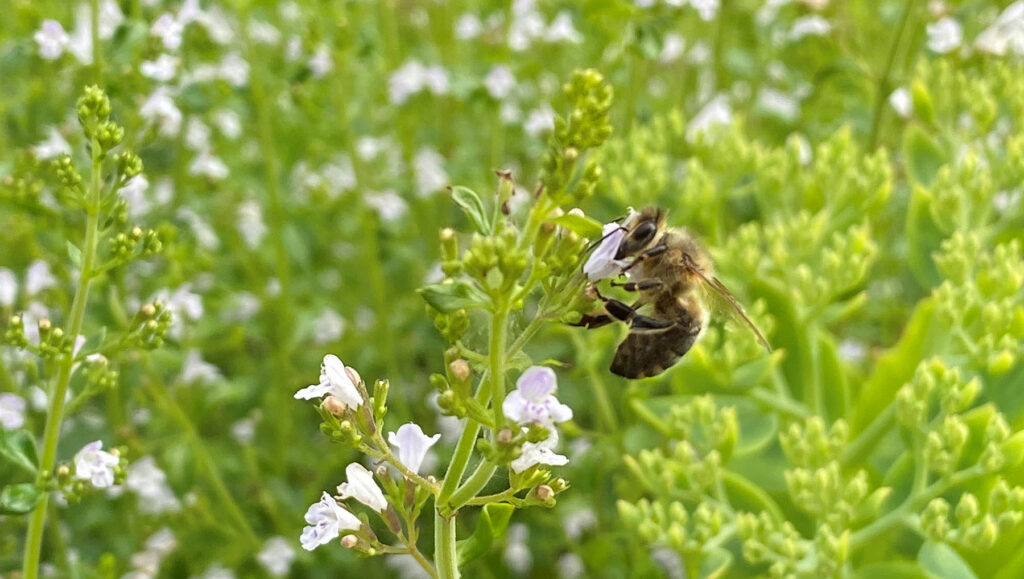
The impact of bees is significant. They play a key role in the pollination of ornamental plants, agricultural crops and wild flora. Without pollinators, biodiversity comes under pressure.
For a sector like ours, that link is obvious. What happens in the garden ties in seamlessly with what we promote professionally.
A garden that works for bees
When designing the garden, a conscious decision was made to include a wide and varied range of plants. The aim: to provide food from early spring through to autumn.
Trees such as lime, willow and serviceberry form an important foundation. These are complemented by perennials such as echinacea, astrantia, lavender and catmint, which flower throughout the season.
Flower bulbs also play a role, particularly in early spring when food is scarce.
The result is a garden that is constantly evolving. No neatly mown lawn, but a functional ecosystem where nectar and pollen take centre stage.
Added value right down to the vegetable garden
In addition to the ornamental garden, there is also a vegetable garden. There, the effect of pollination is immediately visible. Crops such as courgettes and beans depend on insects.
More bees simply means a better yield.
The vegetable garden is also a learning environment. For the children, the presence of bees is a matter of course. They grow up with knowledge of nature and actively share this, including at school.
What makes a garden insect-friendly?
The principles are simple and applicable, even on a smaller scale:
- Spread out flowering periods
- Provide variety in planting
- Mow less closely
- Do not use pesticides
- Leave space for natural areas
Even with limited outdoor space, you can make a difference.
From hive to jar of honey
In young colonies, the honey remains in the hive as food. Stronger colonies produce a surplus. That honey is extracted, matured and processed into a pure end product.
A hive can produce 20 to 40 kg of honey annually, which is distributed within a small community.
Want to start beekeeping?
The most important tip: don’t start on your own. Joining a beekeepers’ association or working with an experienced beekeeper significantly speeds up the learning process.
Leen’s favourite
If there’s one plant that deserves a place everywhere, it’s lavender. Strong, attractive to bees and visually recognisable. A logical choice for any bee-friendly planting scheme.
In a nutshell
What Leen does at home fits perfectly with what Floréac stands for: working with nature, not against it. Small changes make a big difference — for bees, for biodiversity and for the sector as a whole.